
If you’ve recently discovered a cold sore, your first question is likely: When will this be gone? Cold sores are not just physically uncomfortable; they can be socially draining, often appearing at the most inconvenient times.
Biologically, a cold sore is a journey through several distinct stages. While the Herpes Simplex Virus (HSV-1) typically follows a set timeline, the actual duration of an outbreak can vary based on your immune health and how quickly you intervene. According to Mayo Clinic guidelines, understanding this timeline is the secret to cutting your healing time in half.
The Typical Cold Sore Timeline
Without intervention, a standard cold sore outbreak generally lasts between 7 and 12 days. Here is what that window looks like:
- Days 1–2 (The Tingle): You feel a localized itch or burn, but nothing is visible yet. This is the “Prodromal” phase.
- Days 2–4 (The Blister): Small, fluid-filled bumps appear in a cluster.
- Days 4–5 (The Weeping): The blisters burst, leaving a shallow, open sore. This is the most contagious stage.
- Days 5–8 (The Crusting): The sore dries out and forms a yellow or brown scab.
- Days 8–12 (The Healing): The scab falls off, often leaving slightly pink skin behind as it fully resolves.
Factors That Delay Healing
Several environmental and lifestyle factors can “stall” your recovery, turning a one-week nuisance into a three-week ordeal:
- Irritation & Picking: Picking at a scab re-opens the wound and invites bacteria, potentially causing a secondary infection.
- UV Exposure: Intense sunlight is a known trigger for inflammation.
- Low Immunity: High stress or lack of sleep prevents your body from effectively suppressing the virus.
How to Make Cold Sores Heal Faster
While you cannot “cure” a virus instantly, you can significantly accelerate the skin’s repair process by following these clinically supported strategies:
1. The Power of Early Intervention
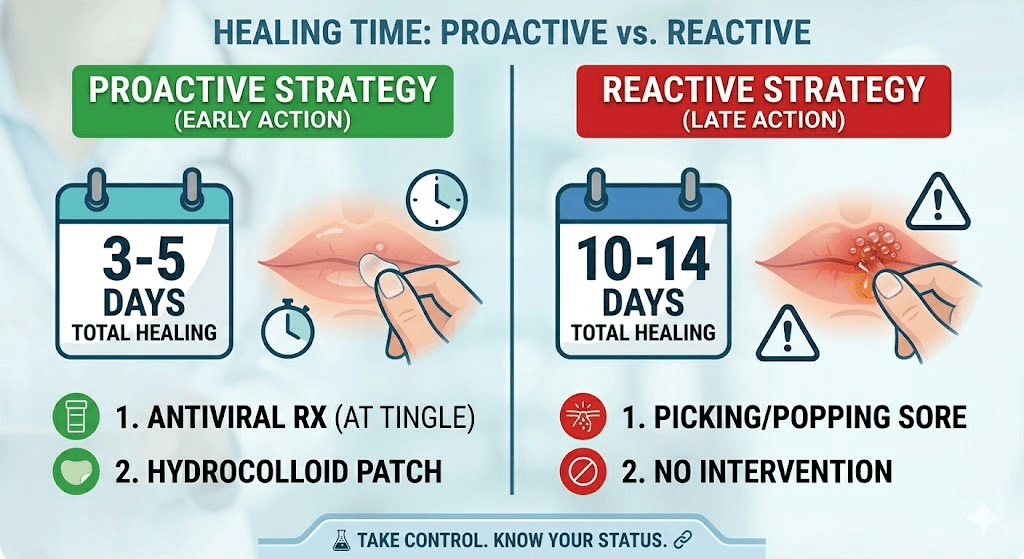
The most effective way to shorten an outbreak is to act during the “Tingle” phase (Stage 1). If you can interfere with the virus’s ability to replicate before the blister forms, you may even prevent the sore from surfacing entirely.
2. Maintain a Sterile Environment
Keep the area clean and dry. Using a hydrocolloid patch is a modern favorite among patient advocates; it creates a moist, protected environment that prevents the sore from drying out too quickly and cracking, which is a major cause of delayed healing.
3. Professional Management
For those looking to move beyond home remedies, clinical interventions are the most reliable way to reduce duration. Antiviral medications, available by prescription, work by blocking the virus’s DNA replication.
When to Seek Deeper Answers
If you notice that your cold sores are lasting longer than two weeks or appearing more than a few times a year, it’s a sign that your current management strategy needs an update.
Knowledge is the ultimate healer. Recurring sores are often a signal from your body that it’s time to take a proactive look at your health. Confusing a cold sore with other conditions can lead to using the wrong treatments, which only extends your discomfort.
If you want to move from “reactive” treatment to “proactive” prevention, consult a healthcare professional. For many, an online HSV test is the most discreet and efficient way to confirm your status and access personalized medical recommendations. Getting the facts allows you to stop the cycle of outbreaks and regain your confidence faster.
FAQs
1. Can I shorten a cold sore once the blister has already formed?
Ans: Yes, but the window for “stopping” has passed. At this stage, your goal is to prevent a secondary infection and keep the area hydrated so the scab heals without cracking.
2. Does icing a cold sore help it heal?
Ans: Ice doesn’t kill the virus, but it reduces inflammation and swelling, which can make the sore less prominent and less painful.
3. Is it normal for a cold sore to last 3 weeks?
Ans: Generally, no. If a sore persists beyond 14 days, it may be a sign of an underlying immune issue or a secondary bacterial infection. You should consult a provider for an evaluation.