
If you’re reading this, you’re likely experiencing “the triad” of vaginitis: itching, burning, and a change in discharge. You know something is wrong, but what?
As a sexual health advocate and writer, I’ve spent over a decade helping people navigate this exact scenario. While your brain might instantly scream “Yeast Infection!” The clinical reality is that there are three conditions. Yeast Infections, Bacterial Vaginosis (BV), and Trichomoniasis share overlapping symptoms.
Self-treating the wrong issue can make things much worse by further disrupting your delicate vaginal pH. Knowing how to correctly differentiate between these three common conditions is the fastest way to get effective, discreet relief. Here is your expert-vetted guide, based on 2026 guidelines from the CDC and Mayo Clinic.
Understanding the Microbiome
Your vagina is home to a complex ecosystem of bacteria and fungi, primarily balanced by “good” bacteria called Lactobacilli. All three of these common conditions occur when this balance is disrupted:
- Yeast Infection: A fungus (Candida) multiplies due to pH shifts.
- Bacterial Vaginosis (BV): Bad bacteria multiply, overtaking the Lactobacilli.
- Trichomoniasis: A single-celled protozoan parasite is introduced.
Key Differentiators to Look For
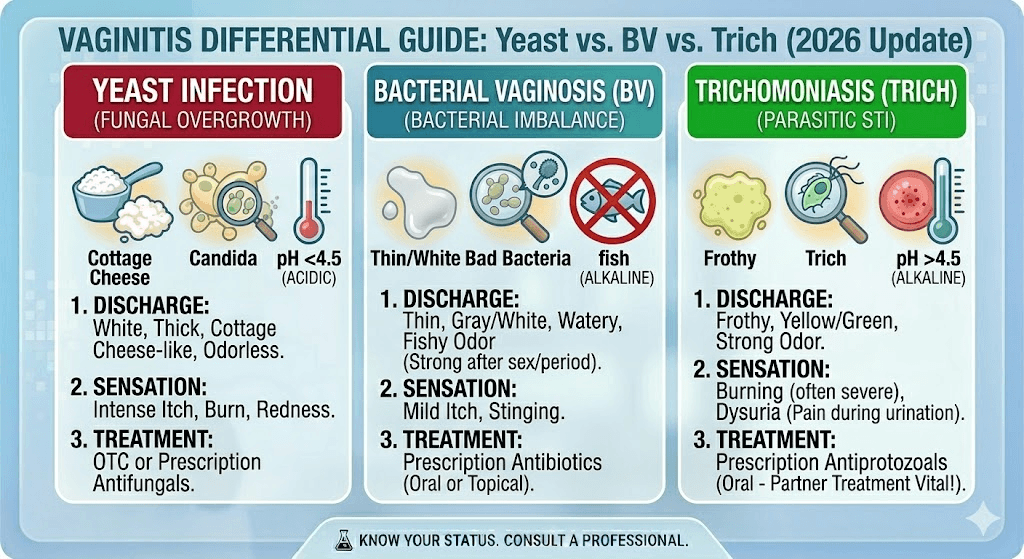
To understand your infection, we must look at the four defining clinical markers: Discharge, Sensation, Odor, and pH.
1. Yeast Infection (Fungal Overgrowth)
- Discharge: The hallmark is thick, clumpy, and white, resembling cottage cheese (or as described in our guide on image_23.png). It may “stick” to the vaginal walls.
- Odor: Almost entirely odorless. If you notice a strong scent, it’s not yeast.
- Sensation: Intense itching is the primary symptom, often occurring both internally and externally (vulvar). It can be so severe it disrupts sleep.
2. Bacterial Vaginosis (BV) (Bacterial Imbalance)
- Discharge: Thin, gray, or white, and watery. It often looks like a milky film rather than clumpy fluid.
- Odor: The classic sign is a strong, distinct, “fishy” odor. This scent is notoriously strong after sexual intercourse or during your period, as semen and blood interact with the bad bacteria.
- Sensation: Mild itching, stinging, or irritation. Often asymptomatic, nearly 50% of people with BV don’t notice any symptoms.
3. Trichomoniasis (“Trich”) (Parasitic STI)
- Discharge: This is the wildcard: Yellow-green, frothy, or bubbly discharge. It can look very different from healthy discharge.
- Odor: Very strong, unpleasant, or moldy scent.
- Sensation: Significant burning, especially during urination (dysuria), and pain during intercourse. You may also notice painful vulvar swelling. Unlike BV and yeast, Trich is sexually transmitted.
The Crucial pH Check
One of the most powerful tools clinicians use to differentiate these three is the Vaginal pH Test. This simple, 60-second test is vital for correct self-diagnosis:
- Healthy Vagina: <4.5 (Acidic).
- Yeast Infection: Usually Healthy pH (<4.5). Yeast doesn’t disrupt acidity; a healthy acidic environment stops bad bacteria.
- BV & Trich: Elevated Alkaline pH (>4.5). Both bad bacteria and the Trich parasite require a less-acidic environment to thrive. If your pH is >4.5, you have eliminated yeast as the sole cause.
Taking Control: What You Must Do Now
Self-treating can seem convenient, but it requires data, not guesswork. Using Monistat on BV will only disrupt your microbiome further, creating a cycle of infection.
Clarity is the first step toward effective relief. If you are using OTC creams multiple times a year, or if your “chapped lips” sensation (as described in our guide on image_18.png) is accompanied by clumpy discharge, you need a diagnosis, not a temporary fix.
True health starts with knowing, not guessing. If you have recurring symptoms, consult a healthcare professional. For many, an online sexual health test is the most discreet and accurate way to confirm exactly which strain of yeast or bacteria is disrupting your microbiome. Getting the facts allows you to move away from “trial and error” with home remedies and toward a clinical plan that restores your balance for good.
FAQs
1. Can you have both BV and a yeast infection at the same time?
Yes. This “coinfection” can be very complex. Often, treating the BV with antibiotics can clear the way for a secondary yeast overgrowth, leading to a “ping-pong” effect.
2. Can BV be transmitted sexually?
Not directly. BV is an imbalance, not a classic STI. However, having new or multiple sexual partners (especially female partners) is a known risk factor because sexual activity can disrupt vaginal pH.
3. Does Trich require treatment for my partner?
Yes. Absolutely. Because Trich is a parasitic STI, it is crucial that all sexual partners are treated simultaneously, even if they have zero symptoms. Otherwise, you risk “ping-ponging” the infection back and forth.