
One of the most anxiety-inducing moments in sexual health is noticing an unexpected itch or change in discharge and immediately jumping to the worst-case scenario. As a sexual health advocate, the question I hear most frequently is: “Is this just a yeast infection, or is it something more serious?”
The short answer is yes. A yeast infection can very easily be mistaken for several Sexually Transmitted Diseases (STDs), also known as STIs. Because the symptoms, itching, burning, redness, and discharge, overlap so significantly, self-diagnosis is notoriously unreliable. In fact, clinical studies show that nearly two-thirds of people who buy over-the-counter yeast infection treatments don’t actually have a yeast infection.
Here is the breakdown of why these mix-ups happen and how you can tell the difference before you start treating the wrong condition.
The Overlap: Why the Confusion?
The vagina and vulva have a limited way of expressing distress. Whether it’s a fungal overgrowth or a bacterial infection, the body reacts with inflammation.
| Symptom | Yeast Infection | Potential STD Match |
|---|---|---|
| Itching | Intense, constant. | Trichomoniasis, Genital Herpes (early stage). |
| Burning | Especially during urination. | Chlamydia, Gonorrhea, Herpes. |
| Discharge | Thick, white, “cottage cheese.” | Trichomoniasis (can be clumpy/frothy). |
| Redness | Visible swelling of the vulva. | Syphilis (early sores), Genital Warts. |
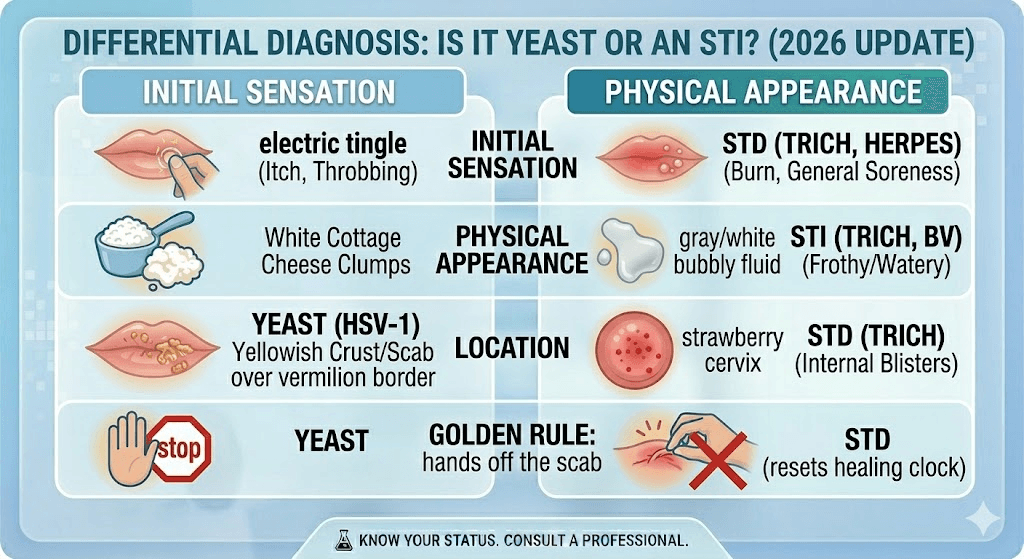
The Most Common “Mistakes”
1. Yeast vs. Trichomoniasis
This is the most frequent mix-up. Both cause intense itching and a change in discharge. However, while yeast is usually odorless and white, Trichomoniasis (a parasitic STI) often produces a foul, fishy odor and discharge that can appear greenish-yellow or frothy.
2. Yeast vs. Genital Herpes
In its very early stages (the “prodrome” phase), a herpes outbreak can cause itching and tingling that feels exactly like the start of a yeast infection. Many people apply antifungal creams to a herpes outbreak, which does nothing to stop the virus and may even further irritate the skin. The key difference? Herpes eventually develops into painful blisters or sores, whereas yeast stays as a general area of redness and irritation.
3. Yeast vs. Chlamydia or Gonorrhea
While these “silent” STIs often have no symptoms, when they do, they cause burning during urination and internal discomfort. Because a yeast infection also causes burning, many people delay the necessary antibiotic treatment for an STI because they assume they just have a stubborn case of thrush.
The Risk of the “Guessing Game”
In 2026, we have more tools than ever to get fast answers, yet many still rely on “mirror checks” and Google. The danger of mistaking an STI for a yeast infection isn’t just the prolonged discomfort; it’s the long-term health consequences. Untreated STIs like Chlamydia can lead to Pelvic Inflammatory Disease (PID) and fertility issues, while an untreated yeast infection can lead to skin tears and secondary bacterial infections.
Moving Toward Certainty
If you’ve used an over-the-counter yeast cream and your symptoms are still there after three days, it is a clinical red flag that you are dealing with something else.
True peace of mind comes from data. If you are sexually active and experiencing symptoms, don’t play the guessing game. Consult a healthcare professional. Today, an online sexual health panel is the most discreet way to test for the most common STIs and vaginal imbalances simultaneously from home. Getting a definitive diagnosis allows you to stop treating a “maybe” and start the specific treatment your body actually needs.
FAQs
1. Can sex cause a yeast infection?
Yes, but not in the way an STD does. Sex can disrupt your vaginal pH (semen is alkaline, while the vagina is acidic), which allows naturally occurring yeast to overgrow. It isn’t “transmitted,” but it can be “triggered.”
2. Should I tell my partner if I think I have a yeast infection?
It’s always a good idea. While men rarely get symptoms, they can occasionally develop balanitis (an itchy rash) from a partner with yeast. More importantly, if it turns out to be an STI, your partner will need treatment too.
3. Does a yeast infection mean I have a weak immune system?
Not necessarily. Stress, antibiotics, hormonal birth control, and even tight gym clothes can trigger an outbreak. However, frequent, recurring infections should be discussed with a doctor to rule out underlying conditions such as diabetes.