
If you’ve been battling a cold sore for the last week, seeing that scab finally start to shrink feels like crossing a finish line. You’ve navigated the tingle, the blisters, and the uncomfortable “weeping” phase. Now, you’ve reached the almost healed stage.
But as a sexual health advocate, I’ve seen many people trip up right at this final hurdle. The end of an outbreak is a delicate time for your skin, and how you handle these last 48 hours determines whether you’ll be left with clear skin or a lingering scar. Here is what is actually happening during the final stage of the Herpes Simplex Virus (HSV-1) cycle and how to ensure a smooth recovery.
What the Final Stage Looks Like
At this point (usually days 8 through 12), the virus has returned to its dormant state in your nerve cells. Your body is now focused entirely on tissue repair. You should notice:
- The Peeling Scab: The hard, dark crust begins to flake off naturally at the edges.
- Residual Pinkness: The skin underneath the scab often looks thin, shiny, or pink. This is a “new” skin that hasn’t yet reached its full thickness.
- Decreased Sensitivity: The sharp, stinging pain is gone, replaced perhaps by a slight itch as the skin knits back together.
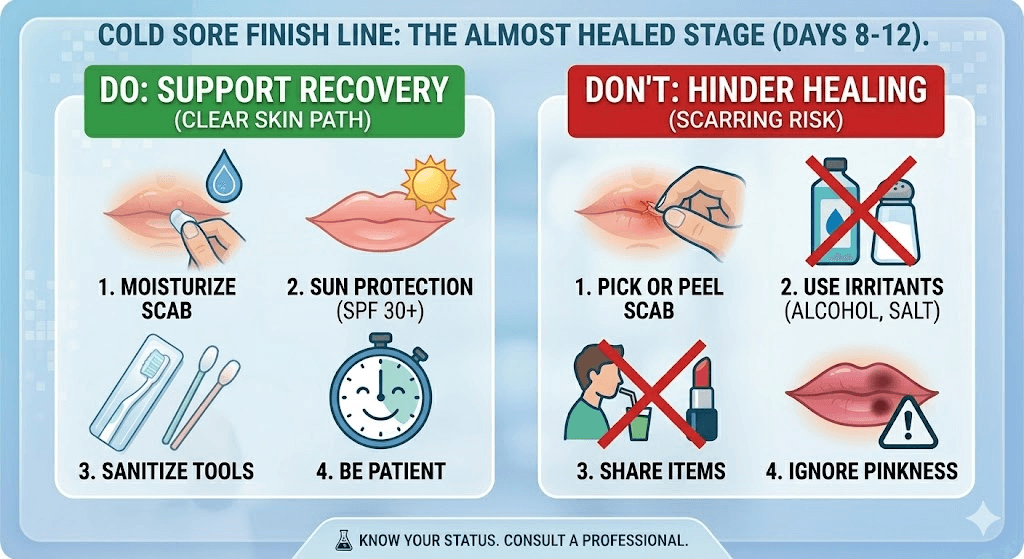
The Golden Rule: Hands Off the Scab
The most important advice I can give you during the almost-healed phase is to stop picking. It is incredibly tempting to peel away a loose scab, but doing so resets your healing clock.
- Why it matters: A scab is your body’s natural “biological bandage.” If you rip it off prematurely, you risk reopening the wound, which can lead to bleeding and, more importantly, a secondary bacterial infection.
- The Scarring Risk: In 2026, we know more than ever about skin regeneration. Picking at this stage is the number one cause of permanent “pitting” or discoloration on the lip line.
How to Support Final Healing
To get your skin back to 100% as quickly as possible, clinical guidelines from the Mayo Clinic and the American Academy of Dermatology (AAD) suggest:
- Hydration is Key: Use a fragrance-free, medical-grade lip balm or petroleum jelly. Keeping the scab soft prevents it from cracking when you smile or eat.
- Sun Protection: New skin is highly sensitive to UV rays. Applying an SPF 30+ lip balm prevents the pink area from turning into a long-term dark spot (post-inflammatory hyperpigmentation).
- Sanitization: Toss your old toothbrush and any lip products you used during the active “weeping” stage to avoid reintroducing bacteria to the healing site.
Moving From Recovery to Prevention
Reaching the final stage of an outbreak is a relief, but it’s also the best time to reflect on why the outbreak happened. Was it stress? A cold? Intense sun exposure?
True health isn’t just about healing; it’s about understanding. If you find yourself reaching this “final stage” multiple times a year, it’s a sign that your management strategy could be more proactive. Many people I work with find that the anxiety of waiting for a sore to heal is worse than the sore itself.
If you’re ready to stop the cycle, consult a healthcare professional. Today, getting an online HSV test is a discreet, clinical way to confirm your status and develop long-term prevention plans. Having the right data allows you to move away from “emergency fixes” and toward a life where you control the virus, rather than it controlling you.
FAQs
1. Is a cold sore still contagious when it’s “almost healed”?
Yes. While the risk is significantly lower than during the “weeping” stage, the virus can still be present until the scab has completely fallen off and the skin underneath is fully restored. Continue to avoid sharing drinks or kissing until the area is clear.
2. Why is the skin pink after the scab falls off?
That pinkness is fresh, vascularized skin. It’s normal! It should fade to your natural skin tone within a few days, provided you keep it protected from the sun.
3. Can I use makeup to cover an almost healed sore?
It is best to wait until the scab has naturally detached. If you must use makeup, apply it with a disposable applicator and never double-dip, as you could contaminate your products.