
Waking up with a cold sore is never ideal, but for the millions of Americans who carry the Herpes Simplex Virus (HSV-1), it is a manageable part of life. While the internet is flooded with “miracle cures,” true home treatment is about supporting your body’s natural healing process and reducing the duration of the outbreak.
As a sexual health care expert, I’ve found that the most successful home treatments are those that focus on the science of viral replication. By following a structured, clinical approach, you can move from the “tingle” to clear skin much faster. Here is your evidence-based guide to managing a cold sore from the comfort of your home.
The Three Pillars of Home Care
Effective home treatment for cold sores relies on three specific goals: Symptom Relief, Barrier Protection, and Viral Suppression.
1. Immediate Symptom Relief
- Cooling Compresses: Applying a cold, damp cloth or an ice pack (wrapped in a thin towel) for 15 minutes several times a day can reduce the throbbing and swelling. This is particularly effective during the early blister stage.
- Pain Management: Over-the-counter (OTC) options such as ibuprofen or acetaminophen are the gold standard for reducing localized nerve pain associated with HSV-1.
2. Protecting the Skin Barrier
- Petroleum Jelly: Applying a thin layer of a simple emollient prevents the sore from drying out too quickly. When a cold sore cracks, it bleeds and scabs more severely, which delays healing.
- Hydrocolloid Patches: These “invisible” bandages are a game-changer. They protect the sore from bacteria and prevent you from accidentally touching or picking at it, which is the #1 cause of the virus spreading.
3. Targeted OTC Topicals
- Docosanol 10% (Abreva): This is the only FDA-approved OTC cream proven to shorten healing time. For it to work, you must apply it at the very first sign of a tingle.
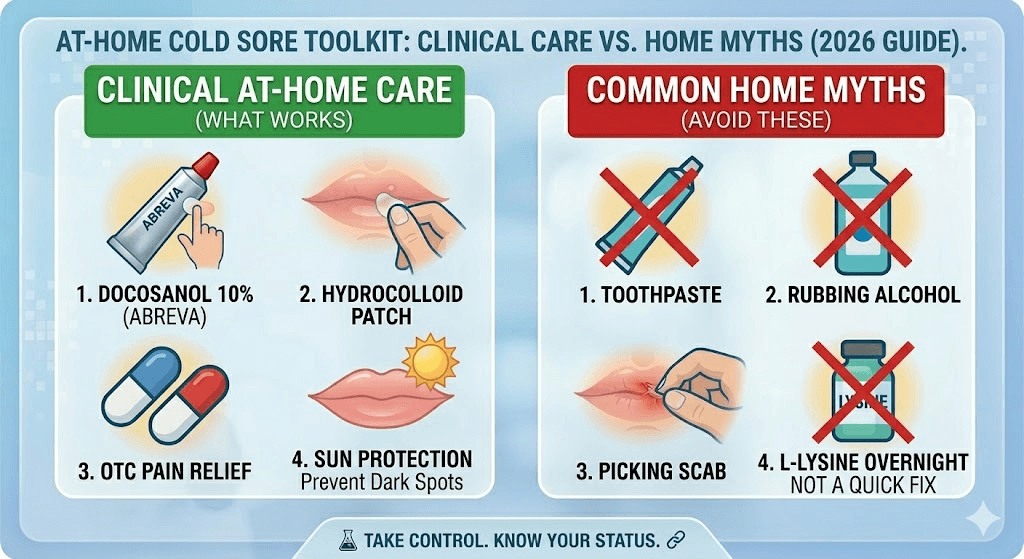
Common Home Remedies: Fact vs. Fiction
In 2026, the medical community continues to warn against “kitchen cupboard” hacks that can do more harm than good.
- Toothpaste: While menthol may feel cooling, the detergents in toothpaste can cause chemical burns to sensitive lip tissue.
- Rubbing Alcohol: This dries the skin so aggressively that it causes the cold sore to crack and bleed, potentially leaving a permanent scar.
- L-Lysine: While some clinical studies suggest this amino acid may help prevent future outbreaks, it is not an “instant” treatment for a sore that has already appeared.
How to Prevent Spreading at Home
Managing a cold sore isn’t just about your own comfort; it’s about protecting those around you.
- Don’t Share: Avoid sharing towels, lip balms, razors, or utensils until the sore is completely healed and the scab has fallen off.
- Hand Hygiene: Always wash your hands immediately after touching the sore or applying any topical treatments.
- New Toothbrush: Once the sore has healed, toss your old toothbrush to avoid harboring bacteria that could complicate future healing.
When to Move Beyond Home Care
Home treatments are excellent for occasional, mild outbreaks. However, if you find yourself reaching for these tools more than three times a year, your body may be signaling that it needs a more proactive approach.
Expertise leads to better outcomes. If your sores are unusually painful, spreading to other parts of your face, or simply not healing with home care, consult a healthcare professional. For many, an online HSV test is the most discreet and efficient way to confirm your status and access prescription-strength antivirals. Getting the facts about your health allows you to move from “managing symptoms” to a personalized prevention plan that keeps you clear and confident.
FAQs
1. Can I use honey on a cold sore?
Ans: Some studies suggest medical-grade Manuka honey has antimicrobial properties. While it may be soothing and keep the area hydrated, it is generally less effective than FDA-approved docosanol.
2. How long should I use home treatments?
Ans: Most cold sores resolve within 7 to 10 days. If your sore persists beyond 14 days despite home care, seek medical advice to rule out a secondary infection.
3. Is it okay to use makeup to cover a cold sore?
Ans: It is best to wait. If you must use makeup, use a disposable applicator and avoid “double-dipping” into your products to prevent contamination.