
When you are dealing with the persistent itch and discomfort of a yeast infection, you don’t want a “maybe” solution; you want what works. As a sexual health advocate, I’ve seen the landscape of vaginal care shift significantly. In 2026, we have more accessible options than ever, ranging from over-the-counter creams to discreet online prescriptions.
However, the “best” medication isn’t just about what is strongest; it’s about choosing the right delivery method for your body and ensuring you aren’t actually dealing with a different type of infection, like BV or an STI. Here is your evidence-based guide to the medications that effectively clear Candidiasis and where you can safely find them.
The Two Main Classes of Medication
Almost all yeast infection treatments fall into a class of drugs called antifungals, specifically “Azoles.” They work by disrupting the cell walls of the yeast, effectively stopping the overgrowth.
1. Topical Azoles (Creams and Suppositories)
These are applied directly to the site of the infection. They are highly effective and have been the standard of care recommended by the CDC for decades.
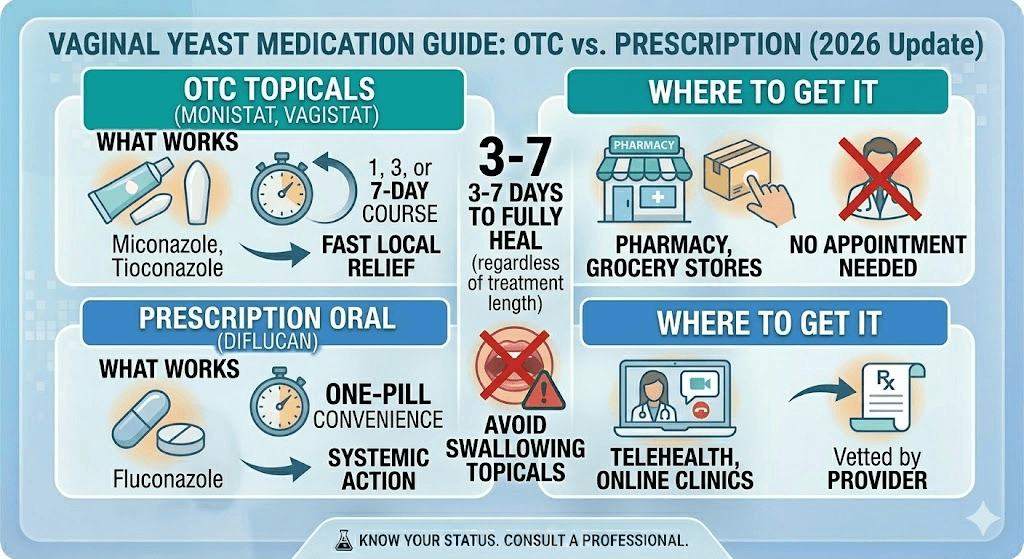
- Miconazole (e.g., Monistat): The most common OTC option.
- Clotrimazole (e.g., Lotrimin): Often used for external itching.
- Tioconazole (e.g., Vagistat-1): A high-concentration, one-dose topical.
2. Oral Antifungals (Prescription Pills)
- Fluconazole (e.g., Diflucan): This is a single-dose pill taken by mouth. It is incredibly convenient but requires a prescription in the United States. It works systemically, meaning it travels through your bloodstream to reach the infection site.
Where to Get Your Medication
Over-the-Counter (Pharmacies & Grocery Stores)
You can find topical 1-day, 3-day, and 7-day kits in the feminine care aisle of stores like CVS, Walgreens, or Target.
- Pros: Immediate access; no appointment needed.
- Cons: Higher risk of self-misdiagnosis. If you treat a bacterial infection with these, your symptoms will likely worsen.
Telehealth & Online Clinics
In 2026, this is the most popular way to get Fluconazole (Diflucan) without a traditional doctor’s visit. Platforms allow you to complete a health questionnaire and, if appropriate, a provider sends a prescription to your local pharmacy.
- Pros: Discreet; no physical exam required; access to the “one-pill” cure.
- Cons: Small consultation fee; it depends on your state’s telehealth laws.
Your Primary Doctor or OB-GYN
If this is your first infection, or if the infection is recurring, a physical visit is the safest bet. They can perform a “wet mount” to look at the yeast under a microscope.
- Pros: Guaranteed accuracy; can test for STIs simultaneously.
- Cons: Requires an appointment; can be time-consuming.
The “1-Day” vs. “7-Day” Debate
A common myth is that a 1-day treatment works “faster.” In reality, both the 1-day and 7-day treatments take about the same amount of time to fully clear the infection (usually 3 to 7 days). The 1-day dose is simply much more concentrated. If you have sensitive skin, I often recommend the 7-day lower-dose option to avoid the intense burning sensation some people experience with high-concentration products.
Moving Beyond the Pharmacy
Medication is vital for clearing an active infection, but it doesn’t always address why the infection happened in the first place.
Knowledge is your best preventive tool. If you find yourself needing medication more than three times a year, you aren’t just treating an infection; you’re managing a chronic imbalance. Consult a healthcare professional. Today, an online vaginal microbiome test is the most clinical way to see exactly which bacteria and yeast strains are present. Getting this data allows you to move away from “emergency” pharmacy runs and toward a long-term prevention plan that keeps your skin clear and your life uninterrupted.
FAQs
1. Can I use antifungal cream for a yeast infection while on my period?
Yes. However, avoid using tampons during treatment, as they can absorb the medication before it has a chance to work. Use pads instead until the course is finished.
2. Is the generic brand as good as Monistat?
Clinically, yes. Look for the active ingredients: Miconazole, Clotrimazole, or Tioconazole. Generic versions are FDA-regulated and must contain the same active drug as the brand-name equivalent.
3. What if the medication makes me burn more?
Mild burning is a common side effect of topical antifungals. However, if the pain is severe or you develop a rash, you may be having an allergic reaction to one of the “inactive” ingredients. Wash the area with plain water and consult a provider.